
Estrogen support for skin that changed after menopause.
After menopause, estrogen levels drop — and so does the collagen, thickness, and hydration of your skin. Estrogen receptors are present throughout the dermis; when they lose signal, skin thins, loses elasticity, and heals more slowly. Topical estriol restores that signal locally, without systemic hormone therapy.
Estriol (E3) is the weakest of the three natural estrogens — 80× less potent than estradiol — which is why it’s the estrogen of choice for topical skin use. It binds skin estrogen receptors to support collagen synthesis and dermal hydration, but has minimal systemic absorption when used topically at low concentrations. Vitamin C 5% provides antioxidant photoprotection and independent collagen support. Hyaluronic Acid 0.5% adds humectant hydration on the surface.
Best fit: peri- and post-menopausal women who notice skin thinning, loss of firmness, dryness, and slower healing since hormonal shifts. Also used off-label for vulvar/vaginal skin changes under separate protocol. Contraindicated in personal or family history of hormone-sensitive cancers (breast, endometrial, ovarian).
Prescription required · Free shipping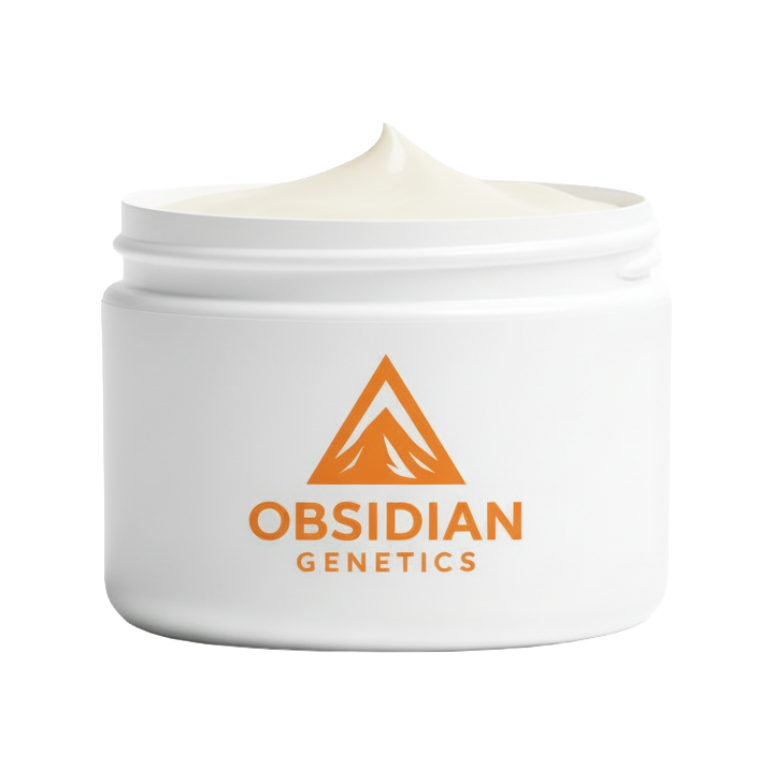
Menopause Skin Cream (Female)
Estrogen shapes your skin.
Skin has estrogen receptors throughout the dermis. Post-menopausal estrogen decline drives the collagen loss and thinning that most women experience in their 50s and beyond.
Post-menopausal collagen loss and estrogen-deficient skin: Rzepecki AK et al., Int J Womens Dermatol 2019;5(2):85-90; PMID 30997378 — comprehensive review documenting ~30% collagen loss in first 5 years post-menopause + ~2%/year thereafter. Sex hormones and skin collagen (classic): Brincat M et al., Br Med J (Clin Res Ed) 1983;287(6402):1337-1338; PMID 6416400 — HRT-treated post-menopausal women had 48% greater skin collagen content than untreated controls. Topical 0.3% estriol pilot: Schmidt JB et al., Maturitas 1994;20(1):25-30; PMID 7877517 — 0.3% estriol cream (same concentration as this product) tested in perimenopausal women.
Topical estriol is prescribed off-label for skin rejuvenation in post-menopausal women. It is not FDA-approved as a skin cream in the US (estriol vaginal cream is FDA-approved in many other countries; the US has more restrictive labeling). Compounded topical preparations are prepared by a licensed pharmacy following individual clinical review.
Three complementary mechanisms.
Estriol 0.3% — Estrogen Receptor Support
Estriol binds skin estrogen receptors (present throughout the dermis) to signal for increased collagen synthesis, improved dermal thickness, and better hydration. Because estriol is 80× less potent than estradiol, topical use at low concentration delivers meaningful local effect with minimal systemic absorption.
Vitamin C 5% — Antioxidant + Collagen Cofactor
Vitamin C serves as an essential cofactor for prolyl hydroxylase, the enzyme that stabilizes newly synthesized collagen — so as your estrogen-signaled fibroblasts try to build collagen, VC provides the raw enzymatic support. Also protects against UV free radical damage.
Hyaluronic Acid 0.5% — Humectant Hydration
HA is a naturally occurring polysaccharide that binds water at the skin surface. Post-menopausal skin loses natural hyaluronic acid as estrogen drops, contributing to dryness and loss of plumpness. Topical HA restores surface hydration.
What to know before starting.
Contraindications: Topical estriol is contraindicated in women with a personal or family history of hormone-sensitive cancers, including breast cancer, endometrial cancer, and ovarian cancer. Disclose all cancer history during intake. Also contraindicated in undiagnosed vaginal bleeding, active thromboembolic disease, and severe liver disease.
Systemic absorption: Topical estriol at 0.3% has minimal systemic absorption compared to systemic hormone therapy. However, some absorption does occur. Women should discuss this with their gynecologist or oncologist if they have any hormone-sensitive concerns.
Pregnancy: Not for use during pregnancy or breastfeeding. Peri-menopausal women should confirm menopausal status before initiating.
Application: Apply 1 gram once daily to face and neck (or affected area). Wash hands thoroughly after application. Do not apply to breast tissue. Avoid contact with children or male partners for at least 2 hours after application.
Onset of effect: Visible skin improvement typically develops over 3–6 months of consistent use. Peak effect is at 6–12 months. Discontinuation returns skin to baseline over subsequent months.
Talk to your gynecologist: If you are being followed for any hormone-related concern (mammogram findings, dense breast tissue, HRT decisions, endometrial issues), let your gynecologist know you’re using topical estriol before starting. Bring this information to your intake as well.
Frequently asked question
Isn't topical estrogen dangerous?
I still have my period — can I use this?
Can I use this with tretinoin?
How long until I see results?
Do I need to keep using it?
Yes. Estriol replaces the estrogen signal your ovaries no longer produce. If you stop, the signal stops, and your skin will slowly return to its post-menopausal baseline over subsequent months. This is a long-term maintenance product, not a short-course fix.
Is this the same as HRT?
No. Systemic HRT typically uses estradiol and delivers it at levels that affect the whole body — bones, cardiovascular system, hot flashes, etc. Topical estriol at 0.3% is a local skin product with minimal systemic effect. It doesn’t treat menopausal symptoms elsewhere in the body. If you also want systemic HRT for hot flashes or bone protection, that’s a separate discussion with your prescribing provider or gynecologist.
Compounded Medication Notice: Estriol 0.3% / Vitamin C 5% / Hyaluronic Acid 0.5% topical is a compounded preparation prepared by a licensed compounding pharmacy. It is not FDA-approved as a finished drug product. Estriol is used off-label for skin rejuvenation in the United States. Compounded medications are prescribed at provider discretion following clinical review. Contraindications: Personal or family history of hormone-sensitive cancers (breast, endometrial, ovarian), undiagnosed vaginal bleeding, active thromboembolic disease, severe liver disease, pregnancy, and breastfeeding. Disclose all cancer history and pregnancy status during intake. Systemic absorption: While minimal at this concentration, some absorption occurs. Discuss with your gynecologist or oncologist if you have hormone-sensitive concerns. Not medical advice: Content on this page is informational only and does not constitute medical advice. Individual results vary. All Obsidian Genetics prescriptions are issued following clinical review by a licensed provider. © 2026 Obsidian Genetics. All rights reserved.