
Oxytocin Nasal Spray. The connection hormone — delivered where it can actually reach your brain.
Oxytocin is the neuropeptide your brain releases during physical touch, intimacy, and orgasm. It shapes how connected you feel, how easily you bond, and how your body responds during sex. When natural oxytocin signaling falters — through age, stress, hormonal shift, or relationship strain — desire and pleasure tend to follow.
Oral oxytocin doesn’t work. The molecule is destroyed in the stomach and cannot cross the blood-brain barrier from the bloodstream in meaningful amounts. Intranasal delivery is the established research route — small lipid-soluble peptide molecules absorbed through the nasal mucosa, with a measurable effect on central oxytocin signaling.
A few sprays before intimacy, prescribed by a licensed provider, compounded by a licensed compounding pharmacy. No needles. No daily pills. Used as needed.
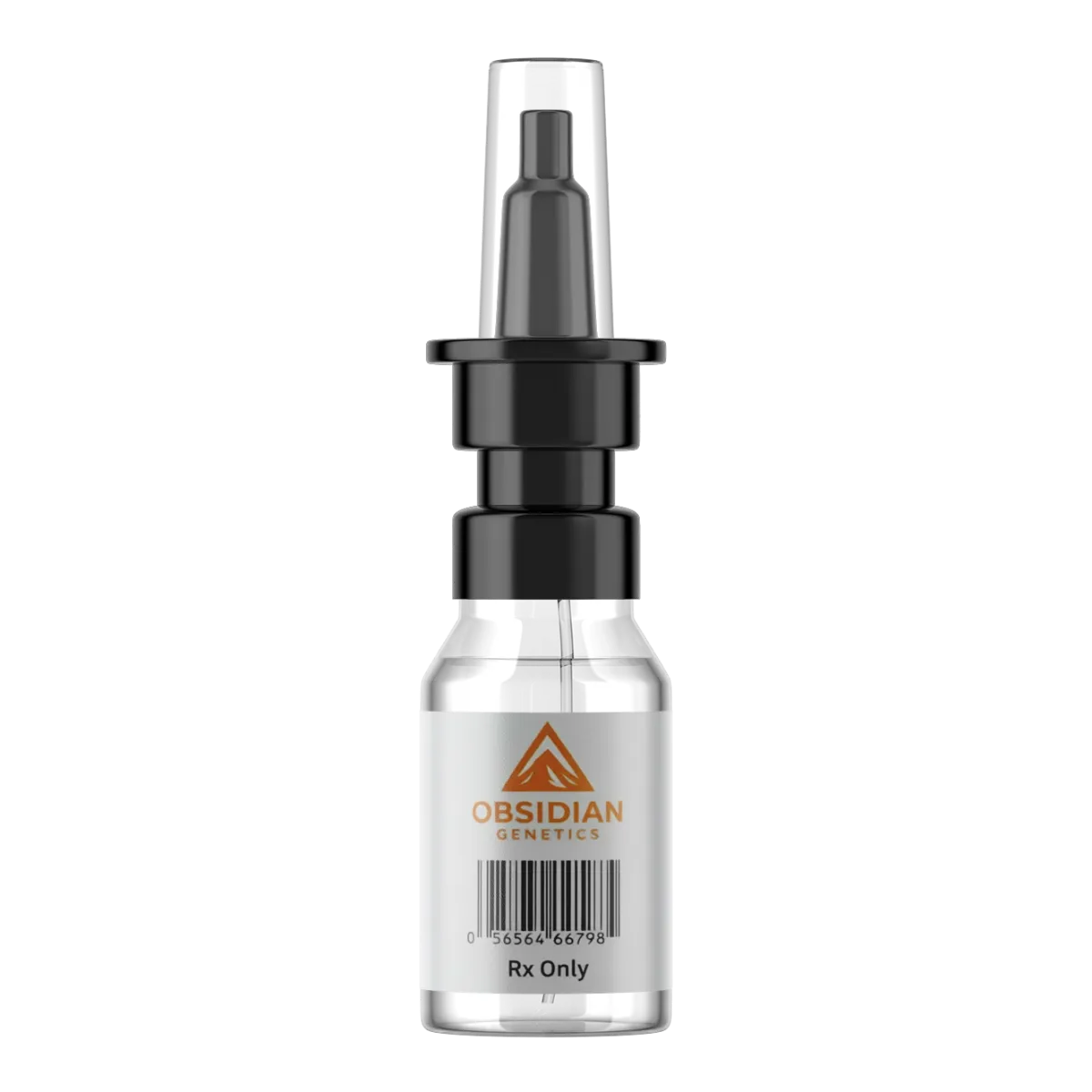
Oxytocin Nasal Spray
Oxytocin and human sexual response is one of the more interesting research areas in modern sexual medicine.
These are findings from peer-reviewed clinical trials of intranasal oxytocin — directly relevant to how the molecule was studied in human sexual function.
Individual results vary. The Muin et al. trial enrolled women with diagnosed hypoactive sexual desire disorder and used a within-subject crossover design — improvements were observed on both oxytocin and placebo arms, with oxytocin trending favorably across multiple measures. The Behnia et al. trial reported increased orgasm intensity, contentment after sexual intercourse, and partner-directed empathy — not change in baseline desire or arousal. Compounded oxytocin nasal spray is not FDA-approved for any sexual indication. Prescription required following a clinical review.
If any of these describe what's been going on for you, oxytocin is worth a real conversation with a provider.
Low Desire, Connected Relationship
The relationship is fine. The connection is fine. Desire just isn't what it used to be. This is one of the most common sexual health complaints — and one of the least well served by traditional medicine.
Disconnection During Sex
Physical function works, but emotional presence during intimacy feels muted. Some patients describe "going through the motions" — the response is there, the closeness isn't.
Postpartum or Perimenopausal Shift
Hormonal transitions can dampen oxytocin signaling and shift the entire experience of intimacy. These changes are biological — and rarely addressed in standard postpartum or menopausal care.
SSRI-Related Sexual Side Effects
SSRIs and SNRIs can blunt sexual desire, arousal, and orgasm. Patients are often told to live with it. Adjunctive options are an active area of research and clinical practice.
High Stress, Low Bandwidth
Chronic stress shifts the autonomic nervous system away from the parasympathetic state required for arousal and pleasure. Oxytocin signaling sits at the center of that recovery.
Anorgasmia or Reduced Climax Intensity
The orgasm response is dampened, delayed, or absent. Trial data show intranasal oxytocin can increase orgasm intensity and post-coital contentment in some users — the mechanism is biologically plausible and being actively studied.
Prescribed For

Oxytocin Nasal Spray vs. Oral or Sublingual Oxytocin.
The molecule itself is fragile. Oral oxytocin doesn't survive digestion. Intranasal is the route used in nearly every published clinical trial of behavioral and sexual response.
Oxytocin Nasal Spray
Intranasal • Compounded peptide
Oral / Sublingual Oxytocin
Tablet / drops • Variable
What oxytocin actually does in the brain and body.
Hypothalamic Release & Central Signaling
Oxytocin is produced in the paraventricular and supraoptic nuclei of the hypothalamus and acts on oxytocin receptors throughout the limbic system, including the amygdala, nucleus accumbens, and prefrontal cortex. Activation of these pathways shifts emotional processing toward trust, reduced threat sensitivity, and heightened social-reward salience — the neural backdrop of intimacy.
Sexual Response & Orgasm
Endogenous oxytocin rises during sexual activity and peaks at orgasm. Trial data with intranasal oxytocin in heterosexual couples (Behnia et al., 2014) reported increased orgasm intensity and post-coital contentment, with no shift in baseline arousal or erectile function. The mechanism is consistent with a modulatory rather than initiating role — amplifying response, not creating it from scratch.
Pair-Bonding & Stress Buffering
Oxytocin reduces HPA-axis reactivity (lowered cortisol in response to social stress) and supports the parasympathetic state required for arousal. It strengthens partner-directed attention and empathy in clinical study designs. The combined effect — calmer nervous system, stronger bond focus — is the biological substrate behind why oxytocin is colloquially called the "bonding hormone."
Safety and what to expect.
Intranasal oxytocin has been widely used in clinical research with a generally favorable side-effect profile. Here is what published trials and clinical use describe.
⚠ Important Cautions
Oxytocin can cause uterine contractions and is contraindicated in pregnancy outside of medically indicated obstetric use. It should not be used by patients who are or could be pregnant. Patients with a history of cardiovascular conditions, hyponatremia, or seizure disorder should disclose those conditions during intake — your provider will determine whether oxytocin is appropriate. Compounded oxytocin nasal spray is not FDA-approved for any sexual health indication; use is off-label and prescribed at provider discretion.
What to Expect — Oxytocin nasal spray is used on-demand, typically a few sprays roughly 30–60 minutes before intimacy. It is not a daily medication. Some patients describe a calmer, more present, more emotionally connected baseline shortly after dosing; effects on sexual response itself are highly individual.
Common Reactions — Mild, transient effects reported in trials include nasal irritation or a brief sensation in the nose, mild headache, sleepiness, lightheadedness, and changes in mood (typically toward calm or sentimentality). Effects are short-lived. Serious adverse events were uncommon in the published trials.
Prescribed and monitored by your care team. All Obsidian Genetics prescriptions follow a licensed provider intake review. Your provider evaluates your health history and current medications before prescribing. Compounded oxytocin nasal spray protocols are personalized — concentration and dosing schedule are matched to your needs and response.
Pricing
Oxytocin Nasal Spray Protocol Pricing
One flat rate. Physician supervision, compounded medication, and ongoing support included.
Pricing to be announced at launch.
Includes: physician consultation · compounded medication · ongoing provider support · free shipping
Frequently asked question
Why nasal spray and not a pill or sublingual tablet?
Oxytocin is a small peptide. Stomach enzymes destroy it before it reaches the bloodstream, so oral oxytocin has poor and inconsistent bioavailability. Sublingual delivery has the same problem at the level of oral mucosa enzymes. Intranasal delivery is the route used in nearly every published clinical trial of oxytocin’s behavioral and sexual effects — it bypasses digestion and reaches central oxytocin pathways more reliably.
How quickly does it work, and how long does it last?
In published trials, intranasal oxytocin is typically administered roughly 30–60 minutes before the activity being studied. Subjective effects, when they occur, tend to be reported within that window. Pharmacokinetic data suggest peripheral oxytocin peaks within 15–30 minutes and central effects on social behavior have been documented for 60–90 minutes after dosing. Individual response varies.
Is this a daily medication or used as needed?
Oxytocin nasal spray is typically used on-demand — a few sprays before intimacy or in moments where the patient and their provider have agreed it would be helpful. It is not designed as a daily medication. Some research protocols have used daily dosing, but for the patient-directed sexual-health use cases this product is prescribed for, on-demand use is the standard pattern.
What does the research actually show?
The two most-cited trials in this space are Behnia et al. (2014) — a randomized, double-blind, placebo-controlled crossover trial in 29 heterosexual couples that found increased orgasm intensity and post-coital contentment with intranasal oxytocin (24 IU) — and Muin et al. (2015) — a 22-week randomized double-blind placebo-controlled crossover trial in women with hypoactive sexual desire disorder that found improvement on multiple validated scales (FSFI, SQOL-F, BDI). Both trials showed significant improvements in some, but not all, sexual function measures. The research supports a modulatory rather than initiating effect — amplification of response, rather than spontaneous desire creation.
Is it safe? Any side effects I should know about?
Intranasal oxytocin has a generally favorable safety profile in published trials. Most reported effects are mild and short-lived — nasal irritation, headache, sleepiness, lightheadedness, mild mood shifts. Important cautions: oxytocin is contraindicated in pregnancy outside of medically indicated obstetric use, can cause uterine contractions, and should be disclosed to your provider if you have a history of cardiovascular disease, hyponatremia, or seizure disorder. Your provider will review your medical history during intake.
Can I use this if I'm on an SSRI?
Many patients ask about oxytocin in the context of SSRI-related sexual side effects. There is preliminary research interest in oxytocin as an adjunct in this setting, but data are limited and this remains an off-label, individualized clinical decision. Disclose all medications during your intake — your provider will assess whether oxytocin is appropriate alongside your current regimen.
Prescription Medication Notice: Oxytocin Nasal Spray is a compounded prescription product prepared by a licensed compounding pharmacy. It is prescribed by a licensed provider following a clinical review. Compounded oxytocin nasal spray is not FDA-approved for any sexual health indication; use for sexual function is off-label and prescribed at provider discretion. Oxytocin is contraindicated in pregnancy outside of medically indicated obstetric use. Patients with cardiovascular disease, hyponatremia, or seizure disorder should disclose those conditions during intake. Results are not guaranteed and individual outcomes vary.
Not Medical Advice: The content on this page is for informational purposes only and does not constitute medical advice, diagnosis, or treatment. Consult a qualified healthcare provider before starting any new treatment. All Obsidian Genetics prescriptions are issued following a clinical review by a licensed provider.
Citations & Evidence: Orgasm intensity, post-coital contentment with 24 IU intranasal oxytocin: Behnia et al., Hormones and Behavior (2014); randomized double-blind placebo-controlled crossover trial, n = 29 heterosexual couples. FSFI +26%, SQOL-F +144%, BDI −36% with intranasal oxytocin in HSDD: Muin et al., Fertility and Sterility (2015); randomized double-blind placebo-controlled crossover trial, n = 27 women (per-protocol). Mechanisms (hypothalamic release, central oxytocin signaling, HPA-axis modulation): standard neuroendocrinology references. Both trials reported improvements on both oxytocin and placebo arms with oxytocin trending favorably across multiple measures.