
The peptide that signals your skin to rebuild itself.
GHK-Cu — the copper peptide tripeptide-1 — is a naturally occurring signaling molecule in human skin. Levels drop sharply with age: from ~200 ng/mL in your 20s to ~80 ng/mL by age 60 (Dou et al., Aging Pathobiol Ther 2020; PMID 35083444). Restoring GHK-Cu topically triggers the same wound-healing and skin-remodeling cascade that keeps young skin looking young.
Unlike tretinoin (which drives cellular turnover) or estriol (which restores hormone signal), copper peptides work at the fibroblast signaling level — telling your skin cells to rebuild collagen, elastin, and glycosaminoglycans. In wound-healing studies, GHK-Cu accelerates tissue regeneration, reduces inflammation, and improves skin firmness. Applied topically as a daily cream, it’s essentially long-term “restorative signaling” for aging skin.
This is our flagship anti-aging product — the one everyone should be using. It layers with everything else (tretinoin, vitamin C, estriol) because the mechanism is orthogonal. Monthly refill cadence; 35-day beyond-use date.
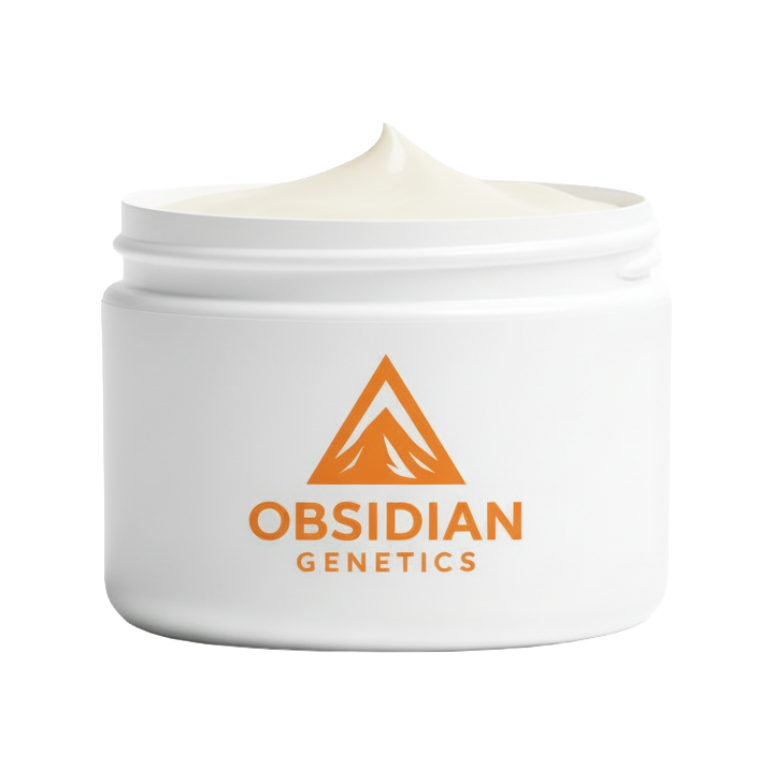
Skin Firmness + Repair (Gold)
Peptide signaling — the third pillar of anti-aging.
Retinoids drive cell turnover. Estrogens restore hormone signal. Copper peptides signal fibroblasts to rebuild the extracellular matrix. Different mechanism, additive benefit.
GHK levels decline with age (200 ng/mL at age 20 → 80 ng/mL by age 60): Dou Y et al., Aging Pathobiol Ther 2020;2(1):58-61; PMID 35083444. GHK tripeptide biology and tissue remodeling: Pickart L, J Biomater Sci Polym Ed 2008;19(8):969-988; PMID 18644225. GHK-Cu in prevention of oxidative stress and aging: Pickart L, Vasquez-Soltero JM, Margolina A, Oxid Med Cell Longev 2012;2012:324832; PMID 22666519. Regenerative gene expression review: Pickart L, Margolina A, Int J Mol Sci 2018;19(7):1987; PMID 29986520.
Copper peptides are a topical cosmeceutical ingredient with a body of laboratory and clinical evidence supporting anti-aging use. Compounded 2% GHK-Cu cream is prepared by a licensed pharmacy following individual clinical review. Not FDA-approved as a finished drug product.
Three ways copper peptides rebuild skin.
Fibroblast Signaling
GHK-Cu binds dermal fibroblasts and signals for increased synthesis of collagen (Types I and III), elastin, and glycosaminoglycans — the structural and matrix proteins that give young skin its firmness, bounce, and hydration.
Anti-Inflammatory + Antioxidant
Copper is a cofactor for superoxide dismutase (SOD), a key antioxidant enzyme. GHK-Cu delivers copper directly to the skin and modulates inflammatory cytokines, reducing the low-grade chronic inflammation that drives visible aging (inflammaging).
Wound Healing Cascade
GHK-Cu was originally studied because it accelerates wound healing. Applied to intact but aging skin, it activates similar remodeling pathways — angiogenesis, matrix reorganization, and tissue regeneration — that support long-term skin renewal.
Four formulas. Matched to your severity.
Copper peptides are the most well-tolerated anti-aging ingredient we prescribe. No irritation, no photosensitivity, no dryness or peeling adjustment period. They layer with everything — tretinoin, vitamin C, estriol, sunscreen — because their mechanism (fibroblast signaling) doesn’t compete with any of the others.
If you’re only going to use one Obsidian Genetics anti-aging product, this is the one to pick. If you’re using multiple, this is the foundation everything else builds on. Monthly refill cadence because the compounded formula has a 35-day beyond-use date — peptides are peptides, and stability matters. We ship on a schedule that keeps your bottle fresh, not one that lets it sit half-used past its effective window.
Frequently asked question
Can I use this with tretinoin?
Yes — recommended, in fact. Tretinoin drives cellular turnover and signals fibroblasts to make collagen; copper peptides provide the enzymatic and signaling support to actually build that collagen. They work synergistically. Apply tretinoin at night, copper peptide in the morning (or both at night with copper peptide first, wait 10 minutes, then tretinoin).
Can I use this with vitamin C?
Historically, dermatologists advised against layering vitamin C and copper peptides in the same application, on the theory that vitamin C might reduce copper to inactive forms. Modern research suggests this concern is overstated for well-formulated products, but the safer approach is to alternate: vitamin C in the morning, copper peptide at night (or vice versa). Your provider can advise based on your specific routine.
Why monthly refills?
Peptides are inherently less stable than small-molecule drugs. Our compounded 2% GHK-Cu cream has a 35-day beyond-use date. Rather than let you get a 3-month supply that partially degrades before you finish it, we refill monthly so every bottle is fresh. The refill triggers around day 24 to make sure you never run out.
Will I see results quickly?
Copper peptides work through gradual matrix remodeling, so results build over months. Most patients notice improved firmness and hydration at 4–6 weeks. Visible wrinkle reduction and skin quality improvement typically develop at 3–4 months. Unlike tretinoin, there’s no initial “getting worse before better” adjustment period.
Do I need to keep using it?
Yes, for continued benefit. Your body makes less GHK-Cu every year; the topical product replaces what’s missing. Stop using it and your skin gradually returns to the same declining signal baseline. This is a long-term daily use product, not a short-course treatment.
Compounded Medication Notice: Copper Peptide (GHK-Cu) 2% cream is a compounded topical preparation prepared by a licensed compounding pharmacy. It is not FDA-approved as a finished drug product. Copper peptides are widely used in cosmeceuticals and have a body of laboratory and clinical evidence supporting anti-aging use; prescription compounded preparations are used off-label at provider discretion following clinical review. Contraindications: Disclose any history of Wilson’s disease, copper metabolism disorder, or significant liver disease during intake. Application: Apply 1 gram once daily to clean skin. Avoid contact with eyes. Discontinue if any signs of irritation or allergic reaction develop. Refills: Monthly refill cadence with 35-day beyond-use date. Refill trigger is around day 24 to ensure fresh product. Not medical advice: Content on this page is informational only. Individual results vary. All Obsidian Genetics prescriptions are issued following clinical review by a licensed provider. © 2026 Obsidian Genetics. All rights reserved.